Lightsprint Press Room
Last verified: 2026-09-01
This is the shared source for public-facing Lightsprint positioning, press
coverage, product proof, and externally defensible company momentum. Trackers
may reuse this language for briefs, outreach, launches, recruiting, investor
updates, and partner materials. Verify time-sensitive facts against the linked
public source before publication.
Company At A Glance
- Company: Lightsprint
- Website: lightsprint.ai
- LinkedIn: Lightsprint (YC P26)
- YC batch: P26
- Category: Collaborative product development and cloud-agent orchestration
for AI-native software teams
- Public LinkedIn description: "Collaborative product development for
AI-native teams"
- Core audience: Cross-functional product teams building on existing
production codebases, plus engineering organizations that need to scale AI
agents with shared review, context, and governance
Approved Boilerplate
One Sentence
Lightsprint is the collaborative development layer for AI-native teams, helping
product, design, and engineering plan together, run cloud agents in parallel,
review working previews, and ship production code with shared context.
Short Boilerplate
Lightsprint helps software teams turn product intent into production changes.
Teams align on code-aware plans and visual options, run multiple cloud agents in
parallel, inspect working previews, and keep engineers in control of review and
merge. The platform is model-agnostic and designed for the coordination demands
that emerge as AI makes code execution faster.
Press Description
Lightsprint is building a shared workspace for AI-native product development.
Instead of leaving planning in documents and coding agents on individual
developer laptops, Lightsprint brings product managers, designers, engineers,
and cloud agents into one workflow. Teams can describe a change, explore visual
directions, align on a code-aware implementation plan, run agents against a
real codebase, review a live preview, and merge with engineering oversight.
Core Public Narrative
The Problem
AI agents are making code generation dramatically faster, but software is still
built by teams. As execution gets cheaper, the bottleneck moves to product
intent, specifications, coordination, shared context, review, and confidence.
Local agents working in isolation do not solve that organizational problem.
The Lightsprint Answer
- A shared planning surface for product, design, and engineering.
- Code-aware specifications grounded in architecture, dependencies, design
systems, and conventions.
- Parallel cloud-agent execution with team visibility and conflict prevention.
- Visual directions and working preview environments before merge.
- Human review and engineering approval for production changes.
- Model-agnostic orchestration so organizational context lives in the workspace,
not in a single model or developer laptop.
Why It Matters
Lightsprint expands who can contribute to production software while preserving
team alignment and engineering control. The public product story is not
"generate an app from a prompt"; it is "help a real team safely ship changes to
a real product."
Who Lightsprint Is For
Lightsprint is built for teams shipping software on an existing production
codebase:
- Cross-functional product teams that want PMs, designers, operations, and
engineers to move from intent to reviewed code together.
- Agent-forward engineering teams that need to run more cloud agents without
losing visibility, quality, or control.
- Enterprise organizations that need governance, traceability, and private
deployment options as agent-generated code scales.
Individual builders can use the same Plan-Build-Preview-PR loop as a starting
point, then bring the workflow to their team.
Product At A Glance
Plan Visually
Describe a change in plain English. Lightsprint reads the real codebase and
design system, then produces a code-aware plan with realistic visual options so
the team can align before code is written.
Build In Parallel
Run multiple cloud agents in isolated environments while the team keeps working.
Lightsprint carries the approved plan and shared context into every run and keeps
parallel work visible.
Preview Every Change
Each change gets a live preview and quality signals, letting product, design,
QA, and engineering review the working result instead of guessing from a ticket
or raw diff.
Review And Ship
Lightsprint turns completed work into a real pull request linked to its plan,
agent run, and preview. Existing CI, security checks, reviewers, and engineering
approval remain in control.
Work As One Team
PMs, designers, engineers, and operations share the same plans, tasks, progress,
previews, and reviews, with GitHub, Linear, and Slack fitting into the workflow
the team already uses.
Keep Team Context
Requirements, decisions, plans, task breakdowns, and review history become
reusable team context. Shared skills and hosted workflows such as gstack help
good practices compound instead of living on one person's laptop.
Govern Agent Work
Enterprise options add role and policy controls, auditability, usage visibility,
identity integration, and private-cloud or VPC deployment so organizations can
increase agent throughput without surrendering control.
Plan Mode Feature Set
Plan Mode is Lightsprint's current codebase-grounded alignment workflow. It
turns a rough product idea into an explicit, reviewable target before cloud
agents write production code. The public story should emphasize better product
decisions, visual alignment, and continuity into implementation.
One-Sentence Description
Turn plain-English product intent into a code-aware, visually reviewable plan
that the whole team can align on before agents start building.
How The Plan Mode Workflow Fits Together
- Describe the desired outcome. A product manager, designer, operator,
founder, or engineer starts with the problem or change in plain English
rather than translating it into an implementation-ready engineering ticket.
- Ground the plan in the existing product. Lightsprint reads the real
codebase, architecture, conventions, and design-system patterns so the plan
starts from how the product already works.
- Pressure-test the idea. Planning and critique workflows can challenge the
user need, scope, assumptions, edge cases, and implementation approach before
the team spends agent or engineering time on the build.
- Surface tradeoffs and options. The plan makes meaningful alternatives
visible instead of silently choosing one interpretation of an ambiguous
request.
- Review the change visually. For user-facing work, the team sees realistic
visual directions styled to the existing application rather than generic
wireframes detached from the product.
- Choose and refine the intended direction. Reviewers can select an option
and request adjustments in plain English while changes are still cheap to
make at the planning stage.
- Align in one shared workspace. Product, design, engineering, and other
stakeholders can review the same plan, decisions, and tradeoffs rather than
reconstructing alignment from separate documents and messages.
- Commit the implementation target. The accepted requirements, visual
direction, specification, and task context become the target handed to the
Build phase.
- Carry context into execution. Cloud agents build against the approved plan
instead of beginning again from the original prompt or an isolated ticket.
- Keep the delivery trail connected. The plan, live preview, review notes,
and pull request stay linked so the original intent remains available when
engineering decides what ships.
Publicly Supportable Capability Set
- Plain-English planning: Let people describe the outcome they want without
first writing an implementation specification.
- Real-codebase grounding: Base plans on the product's existing repository,
architecture, dependencies, patterns, and conventions.
- Design-system-aware visuals: Present options using the components, styles,
type, spacing, and recurring interface patterns of the actual application.
- Tradeoff-led decision making: Show credible alternatives and their
implications before the team commits to one direction.
- Upfront critique: Use planning methods such as hosted gstack to challenge
demand, strategy, scope, architecture, edge cases, tests, design, and developer
experience before implementation.
- Low-cost refinement: Let product and design stakeholders adjust the plan in
plain English before a full code build has to be repeated.
- Cross-functional alignment: Give product, design, operations, QA, and
engineering one shared representation of what is being approved.
- Explicit decision history: Preserve requirements, choices, plan revisions,
and approvals as durable workspace context rather than ephemeral chat history.
- Implementation-ready handoff: Translate the accepted intent into the
specification and task context cloud agents need to execute the change.
- Plan-to-build continuity: Carry approved decisions into agent work so later
phases inherit the team's reasoning instead of reinterpreting the request.
- End-to-end traceability: Keep the requirement, plan, preview, approval, and
resulting pull request connected through the delivery workflow.
- Engineering control: Treat plan approval as agreement on intent and
direction; the resulting code still passes through engineering review, CI,
security checks, and merge approval.
Role-Level Value
- Product managers and founders: Turn a rough idea into a concrete,
challenge-tested plan without waiting for engineering to translate every
product decision.
- Designers: Review realistic directions in the context of the existing
product and refine the intended experience before implementation.
- Engineers: Receive clearer requirements, resolved tradeoffs, and a visible
target, leaving more time for architecture, code quality, and review.
- QA and operations: See intended flows, edge cases, and acceptance context
before testing the implemented change.
- Leaders and regulated teams: Preserve who decided what, why the direction
was chosen, and how that intent connects to the code ultimately reviewed.
Approved Plan Mode Positioning
- "Make the important product decisions before agents start writing code."
- "Plan against the product you have, not a blank canvas."
- "Turn rough intent into a visual, code-aware target the whole team can review."
- "Align on the tradeoffs once, then carry the approved plan into every later
phase."
- "Product approves the intent. Engineering still approves the code."
Slackbot Feature Set
Lightsprint's Slackbot is the Slack-facing collaboration layer for the broader
Plan-Build-Ship workflow, not a standalone general-purpose chatbot. Public
positioning should emphasize continuity: teams can keep product and engineering
work connected to the conversations they are already having, while Lightsprint
provides the shared codebase context, cloud execution, previews, pull requests,
and review path behind that work.
One-Sentence Description
Lightsprint brings its AI-native product workflow into Slack so teams can keep
requirements, cloud-agent work, and engineering review visible across Slack,
the Lightsprint workspace, and pull requests.
How The Slack Workflow Fits Together
- Start where the team already talks. Slack is a supported Lightsprint
integration and is included in the publicly listed Team offering, reducing
the need to move every early product or engineering conversation into a
separate tool.
- Connect conversation to real product context. The surrounding
Lightsprint workflow translates plain-English requirements into code-aware
plans and tasks grounded in the team's existing repository, architecture,
patterns, and organizational context.
- Keep cloud-agent execution visible. Lightsprint's published product
thesis treats Slack, the web workspace, and pull requests as connected
collaboration surfaces rather than isolated places where agent work becomes
fragmented or invisible.
- Move from discussion to reviewable work. Background cloud agents execute
against the real codebase in isolated environments. The broader workflow
produces working previews and real pull requests rather than disposable
prototypes or chat-only answers.
- Keep humans in the approval loop. Product, design, QA, and engineering
can follow the same change, while engineers retain control of review and
merge through the team's existing pull-request and CI process.
- Make context compound. Requirements, plans, task breakdowns, decisions,
agent runs, and review history feed the shared Lightsprint workspace instead
of disappearing inside a private message or one person's laptop.
Publicly Supportable Capability Set
- Slack-native collaboration: Bring Lightsprint into a communication
surface the team already uses.
- Code-aware handoff: Connect plain-English product intent to planning and
execution against an existing production codebase.
- Shared agent visibility: Make cloud-agent activity visible across Slack,
the Lightsprint web workspace, and pull requests.
- Background execution: Let agents continue working in isolated cloud
environments while the team continues its normal work.
- Preview-to-PR review: Carry completed work into live previews, pull
requests, quality checks, and engineering approval.
- Cross-functional participation: Give PMs, designers, operations, QA, and
engineers a shared view of the same delivery workflow.
- Durable team context: Keep plans, decisions, tasks, and review history in
an organizational workspace rather than trapping them in chat.
- Model- and tool-agnostic workflow: Keep Slack as one collaboration surface
inside a workflow that is not tied to a single model or local coding tool.
Role-Level Value
- Product managers and operators: Keep intent close to the conversation,
then move into a code-aware plan and reviewable result without requiring a
local development environment.
- Designers and QA: Review working behavior through previews rather than
trying to infer the outcome from a ticket, chat transcript, or raw diff.
- Engineers: Preserve repository context, CI, pull-request review, and final
merge authority while gaining visibility into agent-driven work earlier.
- Engineering and product leaders: Reduce coordination loss as more agents
run in parallel, while preserving a shared record of what was requested,
built, and reviewed.
Approved Slackbot Positioning
- "Bring AI-native product development into the conversations your team is
already having."
- "Keep cloud-agent work visible across Slack, live previews, and pull
requests."
- "Move from product intent to reviewable production work without losing team
context."
- "Slack is the collaboration surface; Lightsprint provides the shared
planning, cloud execution, and review workflow behind it."
Cloud Sandbox Feature Set
Lightsprint sandboxes are isolated cloud execution environments for work on a
team's real repository. They are not disposable prototype projects: each task
uses a working copy of the authorized codebase, follows the team's setup and
quality workflow, produces a reviewable result, and keeps production merge
authority with engineers.
One-Sentence Description
Every Lightsprint task runs in an isolated cloud environment that can install,
build, test, and preview the team's real application before opening a pull
request for engineering review.
How The Sandbox Workflow Fits Together
- Connect the real repository. Lightsprint uses scoped repository access
and works from the target branch of the codebase the team already ships.
- Create an isolated cloud workspace. A task receives its own ephemeral,
single-tenant execution environment rather than running on a developer's
laptop or gaining ambient access to that machine.
- Reproduce the application setup. The workspace clones the repository and
installs dependencies in the same spirit as the team's CI environment. A
shared setup lets every teammate start from a consistent environment.
- Let the agent work against the full codebase. The agent can inspect the
working copy, follow existing architecture and conventions, edit the relevant
files, and iterate on the requested change.
- Run the quality loop before review. The cloud workspace can run install,
lint, typecheck, test, and build steps, then surface a clear result when a
failure cannot be resolved automatically.
- Preview the working behavior. Each change can produce a live URL so
product, design, QA, and engineering can review the application as a user
would before the change reaches production.
- Ship through the existing Git workflow. The output becomes a real branch
and pull request, with normal CI, comments, requested changes, approvals, and
merge controls still applying.
- Remove the temporary working copy. The ephemeral environment is destroyed
when the task ends, while review artifacts such as the plan, diff, preview,
run record, and pull request remain available for continuity and audit.
Publicly Supportable Capability Set
- Real-codebase execution: Work from a real repository and target branch,
not an abstract code summary or a generated prototype.
- Per-task isolation: Keep each agent run inside a bounded cloud environment
with no ambient access to a teammate's desktop or unrelated local files.
- On-demand environments: Start cloud work without requiring each PM,
designer, operator, or engineer to reproduce a local development setup.
- Consistent team setup: Reuse the same dependencies, services, environment,
and team instructions so results do not depend on one person's laptop.
- Built-in quality loop: Run linting, type checks, tests, and builds before
asking an engineer to review the change.
- Parallel execution: Run multiple tasks in separate environments without
forcing them to compete for one developer machine or block one another.
- Live preview per change: Review working behavior through a shareable URL
before merge.
- Reviewable Git output: Preserve branches, diffs, pull requests, CI, and
engineering approval as the path to production.
- Scoped secret handling: Store secrets encrypted and inject them at runtime
rather than placing them in prompts or generated code.
- Enterprise deployment options: Support configured private-cloud or VPC
deployments where contractually available.
Role-Level Value
- Product managers and designers: Review a working change without installing
the repository or learning a local development toolchain.
- QA and operations: Validate real behavior in a live environment earlier,
while the change is still cheap to revise.
- Engineers: Receive a branch and pull request with execution context and
quality signals instead of an unverified code dump.
- Engineering leaders and security teams: Replace laptop-bound agent work
with bounded execution, shared visibility, repeatable setup, and an auditable
review path.
Approved Sandbox Positioning
- "Real codebase in, tested pull request out."
- "Every agent gets an isolated cloud workspace; every engineer keeps review
control."
- "Preview the working application before the code reaches production."
- "Run cloud agents in parallel without handing them the keys to a developer's
laptop."
- "The sandbox is temporary. The plan, review context, and pull request remain."
Multi-Repository Workspace Feature Set
Lightsprint supports teams that operate more than one repository through
Stacks: named groups of related repositories that share one product and
execution context. A Stack task checks its repositories out side by side,
preserves per-repository review boundaries, and can open a separate pull request
for every writable repository the task changes.
One-Sentence Description
Group the repositories your product depends on, work across them in one cloud
workspace, and keep each changed codebase reviewable through its own pull
request.
How The Multi-Repository Workflow Fits Together
- Authorize only the repositories the team chooses. Repository access is
granted through scoped provider integration rather than a broad personal
token or access to every repository in an organization.
- Group related repositories in a Stack. Custom Stacks bring repositories
from the same GitHub organization into one named product and execution
context, with independent base branches and optional read-only members.
- Work across the real system. A task checks Stack members out side by side
so agents can inspect dependencies, edit the writable repositories involved,
and run shared services or previews.
- Use a consistent Plan-Build-Ship loop. Teams can apply the same visual
planning, cloud-agent execution, live-preview, and pull-request review model
to work that crosses repository boundaries.
- Run work in parallel. Different requirements can progress in separate
isolated environments while the workspace keeps activity visible to the
broader product and engineering team.
- Preserve the correct review boundary. Lightsprint opens a separate draft
pull request for each writable repository the task actually changes, while
read-only and unchanged repositories remain context only.
- Keep organizational context shared. Plans, requirements, decisions, task
breakdowns, and review history remain in the team workspace instead of being
fragmented across local agent sessions.
Publicly Supportable Capability Set
- Multiple authorized repositories: Connect and manage the repositories the
workspace needs without granting indiscriminate organization-wide access.
- One team workspace: Give product, design, operations, QA, and engineering
a consistent place to see plans, agent work, previews, and reviews.
- Real repository context: Ground work in each codebase's existing files,
patterns, conventions, history, and Git workflow.
- Consistent delivery loop: Apply the same Plan-Build-Ship model across the
team's repository portfolio.
- Parallel cloud work: Let separate requirements progress concurrently in
isolated execution environments.
- Repository-native review: Keep branches, pull requests, CI, code owners,
comments, and engineering merge authority attached to the relevant repo.
- Shared organizational memory: Let team decisions and delivery history
compound in the workspace rather than remaining trapped in repo-specific
documents or individual laptops.
- Stack-agnostic coverage: Support teams working across common backend,
frontend, mobile, and systems languages without tying the workflow to one
framework.
Role-Level Value
- Product and design teams: Follow product work through one workflow even
when the underlying software is divided across several repositories.
- Engineers: Keep repository-specific conventions and review controls while
reducing the coordination cost of parallel agent work.
- Platform teams: Standardize how repositories are connected, prepared,
executed, previewed, and reviewed without forcing every contributor onto one
local setup.
- Leaders: Gain workspace-level visibility across a portfolio of codebases
while preserving repository ownership and engineering approval.
Approved Multi-Repository Positioning
- "One product workspace for the repositories your team already ships."
- "Keep every codebase real, every change reviewable, and the delivery context
shared."
- "Apply one Plan-Build-Ship workflow across your software portfolio."
- "Run work in parallel across connected repositories without losing the Git
review boundaries your engineers rely on."
Live Session Preview Feature Set
A Lightsprint session preview is the working application attached to an agent's
delivery context, not a static mockup or a disconnected staging build. It gives
the team a live surface for reviewing what the agent is building while keeping
the approved plan, the resulting code, and the eventual pull request connected.
One-Sentence Description
Watch and test the real application while a cloud agent works, then carry the
same preview context into pull-request review.
How The Session Preview Workflow Fits Together
- Start from approved intent. The team describes the change, reviews the
proposed approach and visual direction, and approves what should be built.
- Build against the real codebase. A cloud agent executes the change in an
isolated environment using the repository's actual files, dependencies, and
conventions.
- Create a preview for the specific change. The application runs in a
preview environment with a live URL tied to that build rather than a shared
staging environment that may contain unrelated work.
- Review the product as a user. Product, design, QA, operations, and
engineering can click through the working behavior before it reaches
production.
- Keep feedback attached to the change. The approved plan, preview, notes,
quality signals, and pull request remain part of the same review path.
- Iterate without blocking other work. Separate tasks can run in parallel
environments, allowing the team to review more than one change without the
builds stepping on each other.
- Move into repository-native review. The finished change produces a real
pull request with the preview available to reviewers alongside the diff.
- Preserve engineering approval. A successful preview demonstrates product
behavior; it does not bypass code review, CI, or the team's merge controls.
Publicly Supportable Capability Set
- A live URL for each change: Open the application produced by a specific
agent build instead of waiting for a shared staging deployment.
- Real application behavior: Review the implemented feature in the running
product rather than relying on a ticket, screenshot, static mockup, or diff.
- Linked plan, preview, and pull request: Give reviewers the original intent,
working result, and code change in one continuous delivery context.
- Cross-functional review: Let product managers, designers, QA, operations,
and engineers inspect the same working change from their respective roles.
- Change-level isolation: Keep each preview grounded in its own cloud
workspace so concurrent agent tasks can be reviewed independently.
- Earlier product validation: Catch visual, interaction, and requirement
problems while the change is still under review rather than after release.
- QA-ready browser surface: Enable the team to click through a real build and,
in supported workflows, run automated QA against that preview.
- Asynchronous visibility: Start a task, leave it running in the cloud, and
return to a live, reviewable result without keeping a developer laptop active.
- Repository-native approval: Pair the preview with the existing branch,
pull-request, test, comment, and merge process.
Role-Level Value
- Product managers and designers: Compare the working result with the
approved intent and give feedback on actual behavior, not an approximation.
- QA and operations: Test a change-specific environment earlier and report
issues while the implementation context is still active.
- Engineers: Review the diff with a working reproduction of the feature in
hand, while retaining final code and merge authority.
- Leaders: See what parallel agent work is producing without turning every
review into a local setup exercise or status meeting.
Approved Session Preview Positioning
- "Review the working application, not a ticket or a diff."
- "Every cloud-agent change gets a live URL before it reaches production."
- "Keep the plan, preview, and pull request connected."
- "See what the agent built while engineering keeps final merge control."
Session Handoff Feature Set
Lightsprint treats a session handoff as the continuation of product intent and
team context when work moves from planning to implementation, from an agent to a
reviewer, or from one teammate or phase to the next. The goal is for the next
participant to inherit the decisions and evidence around the change, not just a
ticket title or an unexplained branch.
One-Sentence Description
Carry approved decisions, visual intent, agent context, and the review trail
forward as work moves between phases, agents, and teammates.
How The Session Handoff Workflow Fits Together
- Capture the intent before execution. The shared plan records what the team
wants, the selected approach, and the product or visual direction to follow.
- Turn approval into build context. The cloud agent works from the approved
plan rather than reconstructing the request from a separate ticket or chat.
- Preserve phase-to-phase continuity. In multi-phase workflows, later agents
can work with the codebase, team decisions, and relevant output from previous
phases already in context.
- Make the work visible to the team. Agent output lives in a shared cloud
workspace rather than remaining hidden in one person's terminal or laptop.
- Attach a working result. The live preview gives the next reviewer a direct
way to understand and test what the session produced.
- Carry the trail into code review. The plan, notes, preview, quality signals,
and pull request remain linked to the same change.
- Support asynchronous continuation. Teammates can return to reviewable
workspace artifacts and continue the process without replaying every prior
conversation.
- Retain human decision boundaries. Product approval transfers intent into
implementation; engineering approval still determines what code ships.
Publicly Supportable Capability Set
- Plan-to-build continuity: Carry the team's approved approach and visual
direction into agent implementation.
- Design-intent-to-code continuity: Keep product and design decisions visible
beside the working implementation and resulting pull request.
- Phase-to-phase context: Give later workflow phases access to the codebase,
team decisions, and relevant output from earlier phases.
- Shared agent-work visibility: Move execution out of individual laptops so
teammates can see, review, and collaborate on the outcome.
- Durable delivery artifacts: Retain the resulting plan, preview URL, run
evidence, and pull-request artifacts needed to audit and understand a change.
- Asynchronous collaboration: Let a teammate pick up review or follow-through
from shared context rather than requiring the original operator to be online.
- Institutional memory: Keep requirements, decisions, and delivery history in
the workspace so team context can compound over time.
- Preview-to-PR traceability: Connect what was requested, what users can test,
and what engineers are being asked to merge.
- Model- and tool-agnostic context: Keep the team's durable workflow in the
workspace rather than tying it to one agent model or developer machine.
- Human approval gates: Preserve distinct product-intent and engineering-code
approvals as the change moves between participants.
Role-Level Value
- Product managers and designers: Hand approved intent into implementation
without reducing it to a disconnected specification or visual file.
- Engineers: Receive the original decisions, working preview, and review trail
alongside the code instead of reverse-engineering the request.
- QA and reviewers: Pick up a change with enough context to test the intended
behavior and report actionable feedback.
- New teammates and leaders: Understand why a change exists, how it evolved,
and what remains to be approved without relying on one person's memory.
Approved Session Handoff Positioning
- "The next person inherits the decisions, not just the ticket."
- "Carry approved product intent from plan to preview to pull request."
- "Keep agent work reviewable when ownership changes."
- "Let the session change hands without losing the shared delivery context."
Product Launch Archive
The following feature families were selected for the public Press Room and
re-verified against the current product on 26 July 2026. Dates identify the
initial public-ready launch or, where shown, a later material expansion. These
descriptions supersede launch-era behavior that has since changed.
GitHub PR Bot
Launched: 17 July 2026
Comment @lightsprint with an instruction in a pull-request conversation or
inline review thread. Lightsprint can resume the active session, start work on
the existing PR branch, or create and link a task when the pull request is not
yet tracked. Requests are processed in order, while one living GitHub comment
links to the session and records its latest outcome.
- Works from new pull-request conversation and inline-review comments.
- Continues the existing PR branch instead of creating an unrelated branch.
- Can adopt an untracked pull request and derive the task from its title and
body.
- Keeps concurrent instructions ordered and the current run visible in GitHub.
Scope boundary: The integration is admin-controlled and off by default. It
requires the Lightsprint GitHub App, write access, and a GitHub identity linked
to Lightsprint; opening or editing a pull request does not launch work by
itself.
Sandbox Security And Managed Egress
Launched: 30 May 2026; managed egress added 13 July 2026
Lightsprint runs development tasks in managed cloud sandboxes and can give every
task in a workspace a predictable outbound network identity. Workspace
administrators can use direct networking, shared static-IP egress on eligible
plans, or a dedicated workspace gateway provisioned by Lightsprint. This makes
it practical to allowlist Lightsprint with private APIs and enterprise systems
while keeping gateway credentials server-side.
- Applies a workspace-level egress mode across its Stacks and new task
sandboxes.
- Publishes the outbound IP information administrators need for allowlists.
- Routes managed egress through hardened gateway paths that block common bypass
routes.
- Detects credential-exfiltration patterns and redacts supported AI-gateway
secrets from output.
Scope boundary: Managed egress provides predictable outbound identity, not
domain-level allowlisting or a complete data-loss-prevention boundary. Mode
changes apply after affected Stacks rebuild, and detection does not claim to
catch every possible secret.
Hosted gstack And GStack Autoplan
Launched: Hosted gstack on 27 April 2026; selectable GStack Autoplan on 8
July 2026
Run gstack with the team in Lightsprint's cloud workspace. GStack Autoplan turns
an ambiguous product idea into a build-ready plan through YC-style Office Hours
questioning, CEO-level scope choices, and Engineering, Design, Developer
Experience, and Strategy reviews. The process produces explicit decisions, a
visual preview, and an implementation specification that can be handed directly
to a cloud-agent task.
- Starts with bounded Office Hours questioning before the team commits to
scope.
- Pressure-tests decisions through product, engineering, design,
developer-experience, and strategy lenses.
- Generates a visual preview and implementation specification from the selected
decisions.
- Hands the completed plan into a startable task with its context attached.
Scope boundary: Hosted gstack is the broader Think-to-Reflect workflow;
GStack Autoplan is the deep planning option inside Plan. Lightsprint Align
remains the standard planning track for ordinary plan creation.
Stacks
Launched: 27 May 2026
Stacks group related repositories from the same GitHub organization into one
product and execution context. Lightsprint checks every member out side by side
in one cloud workspace, lets agents understand dependencies across codebases,
runs shared services and previews, and opens a separate pull request for each
writable repository the task actually changes.
- Supports custom Stacks with up to 50 repositories from one GitHub
organization.
- Allows per-repository base branches and read-only context repositories.
- Shares setup, environment variables, services, previews, skills,
integrations, and test configuration.
- Creates independent draft pull requests only for writable repositories with
changes.
Scope boundary: The default Stack follows workspace repositories
automatically; custom Stacks have fixed membership. Preview links are
unguessable rather than access-controlled, and custom read-only tool allowlists
govern read-only sessions rather than ordinary write sessions.
Managed Repositories And Starter Projects
Launched: 24 April 2026
Workspace owners can create a private repository managed by Lightsprint from a
Next.js, Next.js with Postgres and Auth.js, static web, Flutter, Brain, or empty
starter. Lightsprint connects the repository to the workspace, prepares its
default Stack, and makes it ready for the managed Lightsprint agent. Teams can
later transfer the repository to a personal GitHub account and continue with it
as a standard connected repository.
- Creates a private repository from a maintained starter or an empty baseline.
- Connects the new repository and prepares the default Stack automatically.
- Provisioning-aware starters can attach the services their template expects.
- Supports transfer out of Lightsprint management when the team is ready.
Scope boundary: Creation is owner-only, and managed repositories use the
Lightsprint agent provider. Direct transfer to a GitHub organization is
completed as a follow-on step in GitHub after transfer to a personal account.
Codebase Ask
Launched: 24 April 2026
Choose a Stack and ask architectural, implementation, debugging, or
impact-analysis questions across its repositories. Lightsprint refreshes the
code, investigates relevant files, paths, and history, and returns a cited
answer in a persistent thread. Threads can include images, queued follow-ups,
real-time progress, and workspace sharing. When an investigation reveals
actionable work, Ask can propose a scoped task and owner for human review.
- Investigates all repositories in the selected Stack side by side.
- Uses configured Stack skills, MCP servers, and connected apps where
available.
- Keeps a persistent conversation and visible investigation trail.
- Links existing tasks or proposes a new task without editing the codebase.
Scope boundary: Codebase Ask is a read-only investigation surface, not the
code-writing agent. A person must accept a task proposal before execution, and
repository access follows workspace membership rather than separate
per-repository permissions.
Configurable Cloud Agents
Launched: Public-ready provider configuration on 26 February 2026;
Lightsprint's managed provider added 17 April 2026
Lightsprint supports its managed cloud agent alongside connected Anthropic,
Codex, and Cursor providers. The launch flow keeps provider-specific model,
branch, environment, and credential choices explicit, and teams can save a
default configuration for repeated work while retaining control at launch time.
- Offers a managed Lightsprint execution lane and connected third-party
providers.
- Presents provider-specific model and setup choices without flattening their
differences.
- Preserves launch defaults while allowing per-task overrides.
- Uses shared progress, interruption, and follow-up surfaces across supported
providers.
Scope boundary: Exact model catalogs change over time. Lightsprint's managed
agent can work across an eligible Stack; connected third-party agents operate
within their supported repository scope and do not all share identical session
capabilities.
Shared And Custom Agent Skills
Launched: 10 April 2026
Capture coding standards, domain context, review practices, and repeatable
workflows once, then apply them in task conversations and agent runs. Skills can
be personal, shared with a team, attached to a Stack, or maintained with a
repository and discovered alongside its code. Lightsprint records which
guidance shaped a conversation so teams can make agent behavior more consistent
and inspectable.
- Supports personal defaults and shared Stack-level skills.
- Lets teams create, import, edit, select, and remove reusable instruction
sets.
- Discovers repository-maintained skills during Stack preparation.
- Records applied skills on messages for later review.
Scope boundary: Skills are reusable instructions and context, not
unrestricted plugins or independent execution environments. Repository skill
changes become available after discovery, and external providers may consume
guidance differently.
Lightsprint For Slack
Launched: 11 April 2026
Mention Lightsprint in a Slack channel or open its Assistant to ask a question
about the codebase without leaving Slack. Lightsprint preserves relevant thread
and image context, runs the same Stack-scoped engine as Codebase Ask, and
mirrors the conversation into a live Lightsprint Ask thread. When Ask recommends
work, Slack shows a scoped task proposal with an owner and lets a person create
and launch it explicitly.
- Answers code-grounded questions from mentions and the Slack Assistant
surface.
- Carries thread context and a bounded set of recent images into the
investigation.
- Keeps follow-ups continuous between Slack and the Lightsprint Ask thread.
- Returns progress and completion with links to the task, pull request, or
Review Hub.
Scope boundary: A workspace administrator must install the integration, and
the Slack user's email must match a Lightsprint workspace member.
Private-channel context depends on app access, and the Slack launch action uses
the Lightsprint agent.
Lightsprint For Linear
Launched: 9 April 2026
Assign a Linear issue to Lightsprint or mention the Lightsprint agent, and
Lightsprint can create or update the corresponding task in the selected
repository or Stack. It carries the issue description, discussion,
relationships, labels, and supported Markdown attachments into planning or
execution, then posts progress, pull requests, readiness information, and
completion back to the original issue.
- Maps a Linear team and its workflow statuses into a Lightsprint workspace.
- Bundles parent, sub-issue, comment, label, and supported attachment context.
- Keeps mapped title, description, priority, status, and deletion state
aligned.
- Links the Lightsprint task back to its source issue and returns delivery
results.
Scope boundary: The integration does not create a Linear issue for every
arbitrary Lightsprint task or mirror every comment and assignee change in both
directions. Installation and workflow mapping are administrator-controlled.
Review Hub
Launched: 27 March 2026
Review Hub brings CI, deployments, human review comments, supported review-bot
signals, branch and diff context, and verification screenshots or videos into
the Lightsprint task. It separates unresolved failures from passing or pending
evidence and produces an AI-assisted readiness summary. Reviewers can inspect
the proof, refresh or rerun supported checks, and send an actionable follow-up
that continues work on the existing PR branch.
- Switches among multiple pull requests linked to the same task.
- Combines code-review, CI, deployment, and verification evidence in one view.
- Highlights what needs attention and summarizes current readiness.
- Resumes or launches follow-up work on the pull request's existing branch.
Scope boundary: Review Hub requires a linked pull request and connected
GitHub App. Third-party signals depend on the apps installed for that
repository, and AI-assisted readiness is guidance rather than a guarantee that
a pull request should merge.
Collaborative Plans
Launched: 1 March 2026
Share a plan with the workspace or publish a direct read-only URL, then discuss
decisions beside the plan with contextual comments, resolvable feedback,
real-time chat, quoted plan text, and teammate mentions. Agent and Collaboration
panes can stay open together, so the team can refine the specification without
losing the implementation conversation.
- Supports workspace sharing and direct public read-only access.
- Keeps contextual comments, resolution state, and real-time discussion beside
the plan.
- Notifies mentioned workspace members and links them back to the conversation.
- Lets human collaboration continue while Agent chat remains available.
Scope boundary: Public recipients receive reading access; editing and
collaboration remain workspace capabilities. Superseded email-invitation,
reviewer-voting, and expiring-link flows are not part of the current product
claim.
Press Coverage
TechCrunch: YC Demo Day Standout
On June 18, 2026, TechCrunch named Lightsprint one of the 11 standout startups
from Y Combinator's Spring 2026 Demo Day after speaking with eight investors
about the batch's most closely watched companies.
TechCrunch described Lightsprint as a tool that lets non-engineers build and
ship production features, with product managers choosing visual directions,
AI agents implementing the work, and engineers reviewing and merging the code.
Founders Capital: Portfolio Spotlight
In a public LinkedIn portfolio spotlight observed on July 17, 2026, Founders
Capital described Lightsprint as a collaborative product-development platform
for software teams and said it was proud to back the company alongside Jeremy
Hindle as part of the YC P26 cohort.
The post highlighted visual planning, parallel cloud agents, pull-request
preview environments, and a workflow that lets non-engineering teammates take
part from requirements through shipped code. Treat those product descriptions
as the investor's public characterization, not independent verification that
every named capability is generally available.
- Post: Portfolio Spotlight: Lightsprint (YC P26)
- Publisher: Founders Capital
- Observed: July 17, 2026; the LinkedIn post was shown as one week old
- Use publicly: "Featured by investor Founders Capital in a public portfolio
spotlight on collaborative product development with cloud agents."
Public Product Proof
The following claims were publicly posted by Lightsprint and should be
presented as company-reported product capabilities unless independently
verified elsewhere.
- Lightsprint has publicly named Codex, Claude, Cursor, and other agent/provider
integrations across its pricing and company posts; the exact
current matrix must be rechecked before publication.
- Teams can steer supported cloud agents during execution.
- Lightsprint has publicly announced support for multiple frontier models, but
exact model names and versions should be treated as dated launch claims.
- Lightsprint hosts gstack as a team workflow spanning Think, Plan, Build,
Review, QA, and Ship against a real codebase in isolated cloud environments.
- A non-technical Lightsprint intern reportedly shipped a production feature
from plain-English intent to preview and pull request in about 15 minutes,
followed by engineering review and merge.
- Public workflows emphasize real codebases, live previews, pull requests, and
engineering approval rather than disposable prototypes.
- Lightsprint has demonstrated code-aware planning, visual option generation,
parallel agents, preview environments, and shared task context.
- In its July 15, 2026 article, Lightsprint publicly framed the emerging
"product builder" as a product manager or designer who can move from customer
intent into a reviewed change on the real codebase, while engineers retain
architectural, testing, and merge control. This is company-authored
positioning, not independent proof that every described workflow or product
capability is generally available.
Product Announcement: Automations
As of August 19, 2026, Lightsprint offers Automations as a shared workspace
surface for repeatable work. Teams can start from a template or from scratch,
choose how an automation begins, configure the Lightsprint task it should
launch, and inspect resulting activity from the same workspace.
What Automations Add
- Start from a reusable shape. Choose a template or create an automation
from scratch for the workflow the team wants to repeat.
- Choose the trigger. Configure how the automation begins, including a
recurring schedule.
- Define the work. Set the Lightsprint task that should be created when the
trigger fires.
- Review activity. Inspect automation activity and outcomes without
reconstructing recurring work from separate tools.
Claim Boundaries
- Automations follow the workspace's existing access and configuration.
- Trigger and integration availability can depend on the workspace and the
selected automation.
- An automation starts Lightsprint work; it does not bypass the review,
repository, or merge controls attached to that work.
Public Source Ledger
- Automations product announcement,
company-reported release dated August 19, 2026.
- Product interface screenshots captured from a Lightsprint test workspace and
reviewed for public launch use on September 1, 2026.
Product Announcement: Auto-merge
As of July 29, 2026, Lightsprint offers Auto-merge as an explicit per-task launch
choice for taking an agent run through pull-request review and merge. When
Review Hub finds unresolved work, Auto-merge sends its actionable feedback back to
the agent on the same pull-request branch. It merges only after readiness
reaches 100/100 and the available CI signal is settled and green.
One-Sentence Description
Start a task in Auto-merge mode and let Lightsprint fix, verify, and merge the pull
request when it clears the release gate.
How Auto-merge Works
- Choose Auto-merge for this task. Auto-merge is an explicit launch choice, not a
remembered default for future tasks.
- Build against the real repository. The agent works in Lightsprint's
normal cloud workflow and opens or continues the task's pull request.
- Act on review feedback. When readiness is below 100/100 and CI has
settled, Lightsprint sends the Review Hub's actionable feedback back to the
agent on the same branch.
- Keep the loop bounded. Auto-merge sends at most three automated fix
follow-ups. If the pull request still cannot clear the gate, it stops and
hands the task back for human review.
- Merge through the normal GitHub path. At 100/100 readiness with settled
green CI, Lightsprint uses the repository's existing merge or merge-queue
path.
Approved Positioning
- "Auto-merge takes a task from agent run to merged pull request."
- "Fix against Review Hub evidence, then merge at 100/100 readiness with green
CI."
- "An explicit autopilot for the work you are ready to let Lightsprint ship."
Claim Boundaries
- Auto-merge is opt-in per task and is shown only to workspace roles that have merge
permission.
- Auto-merge does not bypass CI, repository rules, GitHub permissions, or the
configured merge queue.
- The 100/100 readiness score is AI-assisted guidance backed by a separate
deterministic green-CI requirement.
- The automated fix loop is capped at three follow-ups. Permission, linkage,
configuration, unresolved checks, or exhausted attempts can stop Auto-merge and
return the pull request to human review.
- Exact availability can depend on a connected GitHub repository, a linked
pull request, Review Hub evidence, and the workspace's merge permissions.
Public Source Ledger
- Lightsprint Press Room — first-party
Lightsprint release and company-reported capability; checked July 29, 2026.
- Lightsprint homepage — real-codebase work, live
previews, pull requests, and the established Plan–Build–Ship workflow;
checked July 29, 2026.
- Lightsprint FAQ — current public workflow and
GitHub integration context; checked July 29, 2026.
Product Announcement: Codex Joins The Lightsprint Agent
As of July 28, 2026, Lightsprint presents Codex as one execution option inside
its collaborative Plan–Build–Ship workflow. Teams can connect the real
repository, run work in a cloud workspace, follow progress as the agent works,
review a live preview, and hand the result to engineering as a pull request.
One-Sentence Description
Bring Codex into the shared path from product intent to pull request.
Approved Positioning
- "Codex joins the Lightsprint Agent."
- "Bring Codex into the shared path from product intent to pull request."
- "Work from an existing codebase, review a live result, and keep engineering
approval in control of the merge."
Claim Boundaries
- Codex is one supported engine within Lightsprint's model- and tool-agnostic
platform.
- Exact model catalogs and plan availability can change; use the current
pricing page for packaging details.
- The agent prepares code and pull requests; engineering approval remains
required before production merge.
- The public screenshot is redacted to remove repository names and internal task
identifiers.
Public Source Ledger
- Lightsprint homepage — Plan, Build, Ship workflow,
cloud agents, previews, pull requests, and model-agnostic positioning;
checked July 28, 2026.
- Lightsprint FAQ — real-codebase cloud work,
isolated workspaces, live previews, pull requests, and Codex provider
language; checked July 28, 2026.
- Lightsprint pricing — current Codex plan
language and packaging; checked July 28, 2026.
Product Announcement: Preview Testing And Screenshot Verification
As of July 24, 2026, Lightsprint cloud agents can open the preview environment
attached to their session, navigate to the application route they changed, test
bounded browser interactions, and capture screenshot evidence of the resulting
UI. The screenshots stay connected to the task's verification set and review
path so teammates can inspect what the agent actually exercised before deciding
whether to merge.
One-Sentence Description
Lightsprint agents can now open the working preview, exercise the changed UI,
and capture screenshot evidence for task and pull-request review.
How The Verification Loop Works
- Open the change-specific preview. Lightsprint resolves the running
application attached to the agent session instead of testing an unrelated
shared staging build.
- Navigate to the changed route. The agent points the preview at the
relevant app-relative path and checks that the route responds before treating
it as reviewable.
- Exercise the UI. For states without their own URL, the agent can use a
bounded set of declarative interactions such as click, fill, key press,
hover, and wait-for-element while remaining on the same preview origin.
- Capture the result. Lightsprint takes the screenshot from the live
preview and records the route, label, viewport, and capture result.
- Keep evidence current. Agents are prompted to collect verification while
running project checks and to replace stale screenshots when follow-up work
changes the UI.
- Review before merge. Captures surface with the task's verification and
Review Hub context and can be carried into pull-request review alongside
code, checks, and human feedback.
Verified Preview Example
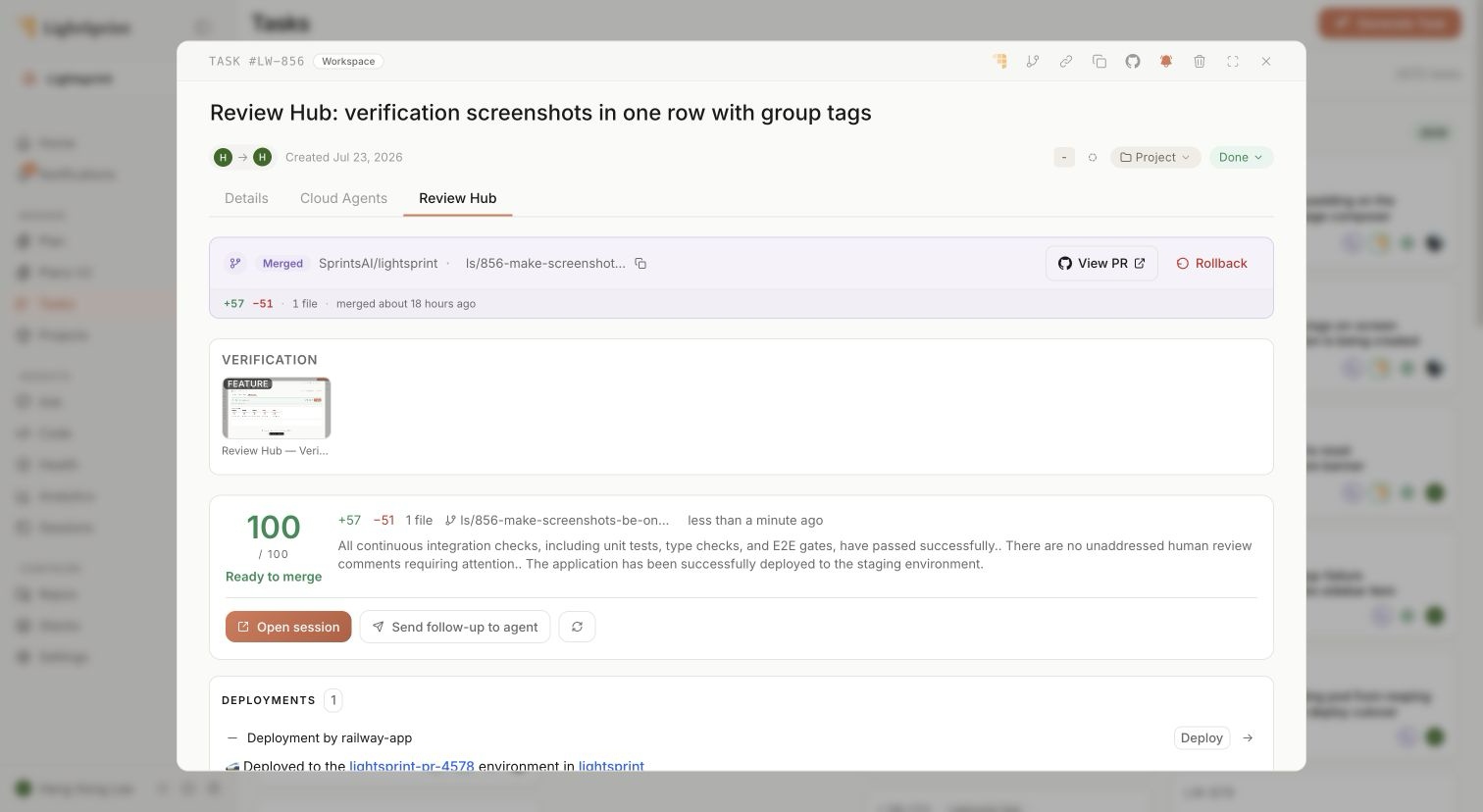
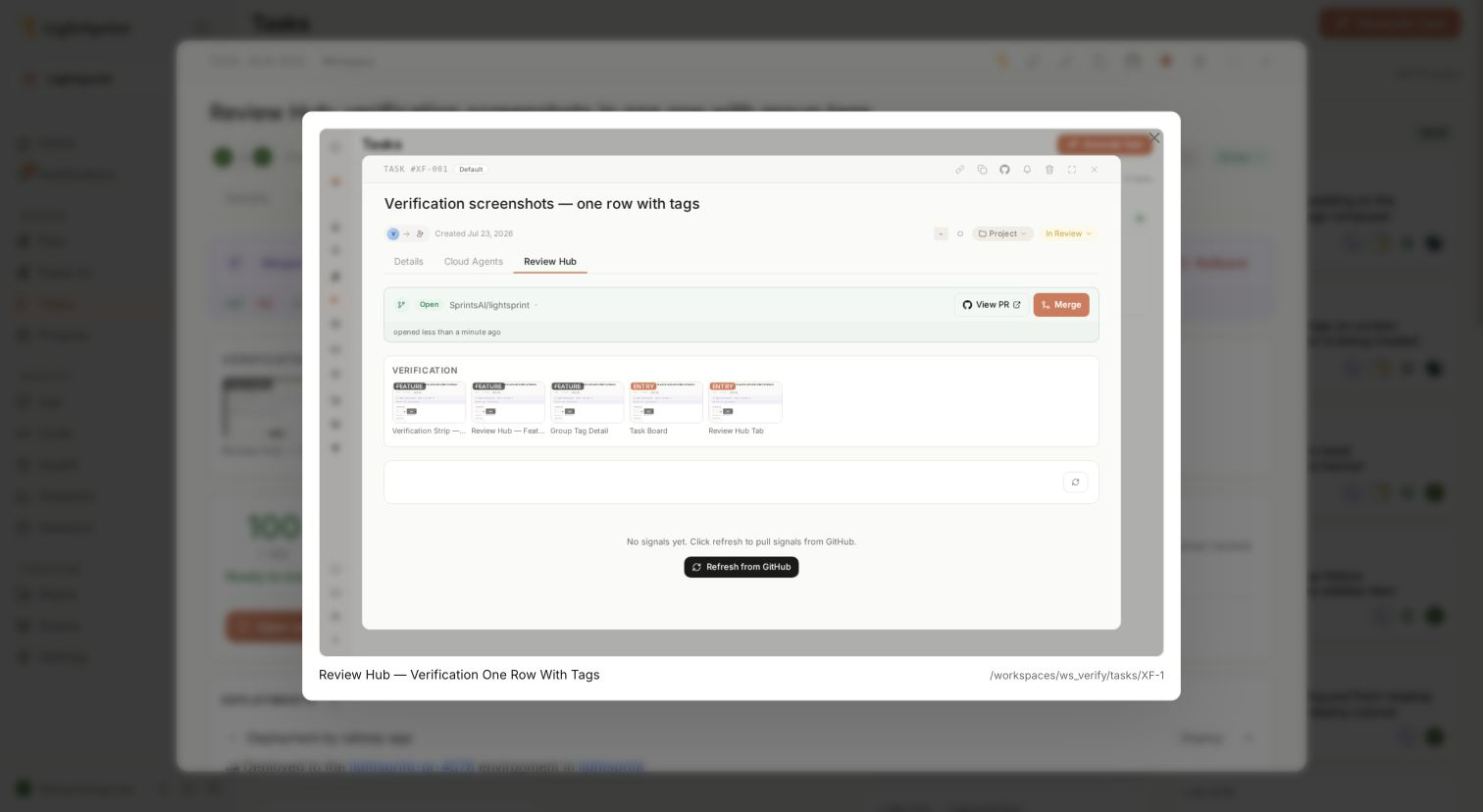
The first image shows screenshot evidence surfaced directly in Review Hub
alongside the merged pull request and readiness result. The second shows a
verification screenshot opened in the Review Hub lightbox for closer
inspection.
Screenshot verification in Review Hub
Screenshot lightbox
Public Launch Evidence
Lightsprint's public QA Screenshot Verification launch post
includes a short product video. It describes the agent running the workflow in a
sandbox and capturing screenshots as visible completion evidence. First-party
source, checked August 5, 2026.
Approved Positioning
- "Open the preview, test the change, and show reviewers what happened."
- "Turn a live preview into screenshot-backed verification before merge."
- "Give reviewers evidence from the working application, not just a completion
message."
- "Keep the changed route, tested state, screenshot, checks, and pull request in
one review path."
Claim Boundaries
- Screenshot verification complements project tests, CI, code review, and human
acceptance; it does not guarantee that a change is bug-free.
- Describe the capability as testing specified routes and bounded interactions,
not as exhaustive autonomous QA of every application flow.
- Authentication- or data-dependent routes may require an appropriate preview
session and seeded test state before they can be captured.
- Captures prove the visible state shown at the recorded route and viewport;
they do not by themselves prove backend correctness, accessibility,
performance, or cross-browser coverage.
Product Announcement: Preview Navigation
As of July 25, 2026, Lightsprint can keep a session's live preview aligned with
the page the work is about. An agent can direct the preview to a relevant route,
and the preview bar follows navigation that happens inside the running app.
One-Sentence Description
Keep the live preview on the page the task is changing.
Approved Positioning
- "Keep the live preview on the page the work is about."
- "Follow the agent and the app without losing the route in between."
Claim Boundaries
- Preview navigation stays within the session's live preview.
- Users can turn off automatic agent-driven navigation.
- It does not replace product testing or grant access beyond the running preview.
Product Announcement: Point To Change
As of July 20, 2026, Lightsprint lets users point directly at visible elements
in a live preview and carry that context into the next instruction. The agent
receives the selected element and its page context, helping it locate the
intended part of the running product more directly.
One-Sentence Description
Point at the interface and give the agent the right context.
Approved Positioning
- "Point at the interface and give the agent the right context."
- "Show the agent what you mean in the running product."
Claim Boundaries
- Point To Change supplies context for an instruction; it does not edit by itself.
- Source-location hints depend on what the previewed application exposes.
Public Momentum
Y Combinator And Community
- Lightsprint is a YC P26 company and launched publicly through Y Combinator.
- At the GStack x GBrain hackathon at Y Combinator,
Lightsprint reported roughly 250 builders, multiple demos powered by
Lightsprint, and a dedicated Lightsprint track.
- At Build YC's Next Unicorn - Agent Hack Day
at AWS Builder Loft, Lightsprint's founders ran a hands-on workshop and the
winning team built its radiology-reasoning project with Lightsprint.
- Lightsprint founders have run hands-on workshops where teams incorporated the
product into live hackathon builds.
- The company has presented its team-oriented cloud-agent thesis at AI Engineer
Singapore, Singapore AI & Robotics Demo Night, and other builder events.
Public Ecosystem Engagement
These are public engagements, not customer or commercial endorsements unless a
separate public source explicitly says otherwise.
- AWS: YC office hours on scaling infrastructure reliably.
- Google DeepMind: Public interaction with its startup team and use of
frontier Gemini models.
- 65labs: Hosted a Lightsprint talk on cloud agents and the software
development lifecycle at AI Engineer Singapore.
- Menlo Research: Hosted a Lightsprint presentation at Singapore AI &
Robotics Demo Night.
- ShopBack: Lightsprint publicly hosted members of ShopBack's leadership
team for an AI-native organization discussion.
- SGCarMart: Lightsprint publicly shared an on-site discussion with SGCarMart
leadership about AI workflows and internal AI initiatives.
External Validation
- TechCrunch's Demo Day roundup placed Lightsprint among 11 investor-flagged
standouts from the YC Spring 2026 batch.
- Investor Tatijana Janko publicly described Lightsprint as a technically honest
response to the gap between isolated coding agents and team-built software,
highlighting parallel cloud agents, conflict prevention, model independence,
and workspace-level institutional memory.
- A public Lightsprint post attributed to Garry Tan described its GStack-powered
experience as "the fastest way to get going on creating new things."
Messaging Pillars
- Software is built by teams. Lightsprint makes AI-assisted development a
shared product, design, and engineering workflow.
- Execution is no longer the only bottleneck. Better specifications,
context, coordination, and review determine whether AI-generated work ships.
- The workspace owns the context. Lightsprint is model-agnostic; durable
team knowledge should not be trapped in one model or laptop.
- Real products, not throwaway demos. The workflow operates on production
codebases and ends in previews, pull requests, review, and merge.
- Broader participation with engineering control. Non-engineers can drive
product changes while engineers retain final review authority.
Reusable Headlines
- The collaborative development layer for AI-native teams
- Run cloud agents in parallel without losing team alignment
- From product intent to reviewed production code
- Software is built by teams. AI agents should be too.
- When execution gets cheap, alignment becomes the bottleneck
Claim Guardrails
- Keep the detailed capability taxonomy in FEATURE_SET.md and
audience qualification in ICP.md. The summaries above are public
positioning, not a guarantee that every enterprise option is enabled in every
workspace.
- Use the live pricing page, not the FAQ, as
the authority for current tier names, prices, credits, seats, and BYOK
packaging; the two pages were inconsistent when reviewed on 2026-07-11.
- GitHub is the publicly documented self-serve repository integration. Confirm
GitLab or Bitbucket production availability before naming either as supported.
- Treat SSO/SAML, private-cloud or VPC deployment, exportable audit evidence,
policy controls, and custom integrations as enterprise/configured features;
confirm scope for the specific customer or publication.
- Validate exact model and agent-provider names immediately before use. Prefer
"model- and tool-agnostic" in evergreen copy.
- Do not claim that post-release metric attribution, an externally visible
knowledge graph, or every path/package guardrail is generally available
without checking the current product or demo.
- Attribute the 15-minute intern example to Lightsprint; it is company-reported.
- Treat LinkedIn follower counts as dated snapshots, not evergreen traction.
The company page showed 770 followers when reviewed on 2026-07-10.
- Do not call ShopBack, SGCarMart, AWS, Google DeepMind, 65labs, or Menlo Research
customers or partners solely from the public posts summarized here.
- Do not imply that every named model or integration remains currently available
without checking the product or latest company post.
- Use "Plan Mode" consistently in public and marketing copy. Do not add an
internal version number unless a future public launch introduces one.
- This section was derived only from the current Plan Mode implementation. Do not
borrow workflows or controls from the outgoing V1 system when describing
current behavior.
- Public sources support codebase-grounded planning, visual options, tradeoffs,
plain-English refinement, critique skills, shared decisions, specifications,
and linked plan-to-PR context. Do not promise a specific internal phase model,
planning-method menu, output-format menu, or artifact type until it appears on
a current public product page.
- Confirm Plan Mode availability for the target workspace before presenting the
feature as generally available.
- Avoid guarantees such as "perfect plan," "zero revisions," "complete codebase
understanding," or "one-shot execution." Say that Plan Mode improves alignment
and gives agents a clearer approved target.
- No dedicated public Slackbot launch page was available when checked on
2026-07-13. Until one is published, use the outcome-level Slackbot language in
this file and do not publicly promise undocumented interaction details,
controls, commands, or notification behavior.
- Use "sandbox" to mean the isolated execution environment around a real
repository. Do not describe Lightsprint output as a sandbox prototype or imply
that generated work bypasses the team's real Git and production workflow.
- Do not name sandbox vendors, internal lifecycle timings, snapshot or cache
behavior, network topology, egress controls, or infrastructure implementation
details unless a current public security or product page explicitly documents
them.
- The FAQ publicly describes multiple repository connections, while the current
pricing page does not list an exact repository allowance. Avoid "unlimited
repositories" in evergreen copy until those public packaging surfaces agree.
- No dedicated public multi-repository orchestration launch page was found when
checked on 2026-07-13. Do not promise a single task changing several repos,
coordinated multi-PR delivery, atomic cross-repo merge, or an integrated
cross-repo preview without a current public source confirming that behavior.
- No dedicated public page documents the exact session-preview interface. Use
outcome-level language and do not promise specific preview controls, device
modes, diagnostic views, recovery behavior, or interaction mechanics without
a current public source.
- No dedicated public launch page documents exact session-handoff controls. Do
not promise undocumented recovery, export, cross-provider transfer, or exact
resume and persistence semantics.
- Use "session handoff" for preservation of approved intent, relevant workspace
context, and the review trail across phases or people. It does not mean account
transfer, credential transfer, or a guaranteed lossless migration between AI
providers.
- Avoid absolute claims such as "zero context loss" or "automatic handoff."
Prefer that context is linked, retained, or carried forward in the workspace.
- Do not cite the formerly indexed
/docs page as current evidence; it returned
404 when checked on 2026-07-11.
- Do not publish private revenue, fundraising, pipeline, customer status, or
roadmap information from tracker or brain files through this press room.
- Prefer "YC P26" and "named a TechCrunch Demo Day standout" over broader claims
not supported by the sources below.
Source Ledger
Primary Sources
- Lightsprint homepage
- Current team-level positioning, Plan-Build-Ship workflow, existing-codebase
focus, visual planning, parallel background agents, live previews, PR review,
GitHub/Linear/Slack integrations, institutional memory, and model-agnostic
positioning.
- Last checked: 2026-07-13.
- Lightsprint FAQ
- First-party detail on repository access, ephemeral cloud workspaces, quality
checks, supported stacks, data handling, secrets, visual options, PM and
engineering approvals, BYOK, and enterprise deployment options.
- Last checked: 2026-07-13.
- Lightsprint for Enterprise
- First-party enterprise positioning around governance, RBAC, policy controls,
code-aware visual planning, approvals, traceability, auditability,
institutional context, SSO, and existing-tool continuity. Enterprise claims
remain deployment- and contract-dependent.
- Last checked: 2026-07-13.
- Lightsprint pricing
- Current individual, team, and enterprise packaging; names publicly included
capabilities such as visual planning, previews, shared workspaces, Slack,
usage analytics, access controls, private deployment, and custom setup.
- Last checked: 2026-07-13. Treat as the authority over conflicting FAQ
packaging details.
- Harvey Built Their Own Software Factory. You Can Too.
- First-party Lightsprint thesis on cloud-agent collaboration: durable agent
runs, shared visibility, and agent work appearing across Slack, the web, and
pull requests so teams can comment, redirect, and review.
- Last checked: 2026-07-13. Treat the Harvey/Spectre examples as context and
the final Lightsprint statements as company positioning, not independent
verification of every Slackbot interaction.
- Why Local Development Is Going Away. Long Live Cloud Agents.
- First-party case for isolated cloud execution, explicit sandbox boundaries,
parallel agents, shared visibility, and a live preview URL for each change.
- Last checked: 2026-07-13.
- Cloud Environments and Shared Skills
- First-party description of on-demand, consistent team environments with
shared dependencies, services, configuration, and agent skills.
- Last checked: 2026-07-13.
- Lightsprint privacy policy
- Public commitments covering scoped repository access, workspace-visible
artifacts, isolated agent sandboxes, least-privilege controls, and the use of
connected repository content to provide the service rather than train
external foundation models.
- Last checked: 2026-07-13.
- Hosted gstack on Lightsprint
- Public workflow for shared cloud execution of Think, Plan, Build, Review, QA,
and Ship phases against a real codebase, including previous-phase context,
team review, live previews, and browser-based approval and merge.
- Last checked: 2026-07-13.
- SDLC of the Past vs SDLC of the Future
- First-party framing of handoff delay and context loss in sequential software
development, and of the Describe-Plan visually-Preview live-Ship workflow.
- Last checked: 2026-07-13.
- Multiplayer Collaboration Is the Future of Development
- First-party explanation of shared product planning: PMs describe outcomes,
Lightsprint reads the codebase and surfaces tradeoffs and visual options, and
engineers review the resulting implementation rather than translating the
request from scratch.
- Last checked: 2026-07-13.
- TechCrunch Demo Day standout article
- Covers Lightsprint's product workflow and investor interest in the YC batch.
- Last checked: 2026-07-10.
- Founders Capital portfolio spotlight
- Third-party investor-authored description of Lightsprint's collaborative
product-development workflow and public statement that Founders Capital
backs the company alongside Jeremy Hindle.
- Observed: 2026-07-17. Treat product-capability language as Founders
Capital's characterization, not independent availability verification.
- Lightsprint LinkedIn company posts
- Public company description, launches, product capabilities, model support,
events, ecosystem engagements, public testimonials, and dated engagement.
- Reviewed through the latest company post exposed by LinkedIn on 2026-07-15.
- The New Product Builder: From Lovable to Claude to the Real Codebase
- First-party Lightsprint article describing a progression from prototype
generation to agent-assisted work on real repositories and, finally, a
shared product-development workflow spanning product, design, engineering,
preview, review, and pull requests.
- Published and observed: 2026-07-15. Treat it as company-authored positioning,
not third-party validation or a guarantee of current feature availability.
- Review Hub screenshot verification
and screenshot lightbox
- First-party Lightsprint Review Hub captures showing verification evidence
beside pull-request and readiness context, plus a captured screenshot opened
for closer inspection.
- Captured from the canonical staging Review Hub task and verified:
2026-07-24.
- Jira Was Built for Scrum. We're Building for What Comes Next.
- Lightsprint's public thesis on specifications, coordination, and shared
context becoming the new software-development bottleneck.
- Last checked from the company feed: 2026-07-10.
- Build YC's Next Unicorn - Agent Hack Day at AWS Builder Loft
- Lightsprint's public account of its workshop and the winning team's use of
Lightsprint during the event.
- Last checked: 2026-07-10.
- GStack x GBrain hackathon at Y Combinator
- Lightsprint's public account of the roughly 250-builder event, product-powered
demos, and the dedicated Lightsprint track.
- Last checked: 2026-07-10.
Maintenance Contract
- Every content-ingesting Lightsprint slurper must evaluate verified public
sources for useful press-room additions. Internal-only health and
observability jobs must never write here.
- Re-check the TechCrunch article if its title, URL, or availability changes.
- Review the Lightsprint LinkedIn company feed read-only at least once daily
when an authenticated, unlocked browser is available, or whenever another
source surfaces a new public launch, press mention, event, testimonial,
integration, or externally shareable milestone.
- Add only facts that are public, useful, source-linked, and defensible.
- Keep detailed feature architecture and ICP strategy in
FEATURE_SET.md and
ICP.md; promote only concise, boast-ready summaries into this file.
- Preserve attribution and distinguish editorial coverage, third-party opinion,
and Lightsprint-reported claims.
- Date volatile figures and remove or refresh stale product availability.
- Keep private tracker state, customer correspondence, revenue, fundraising,
security details, and unannounced roadmap items out of this file.
- Update
Last verified and append a concise entry below after a material
refresh.
Update Log
- 2026-09-01: Prepared the Automations product announcement dated to its
August 19 launch, with a six-image product walkthrough and explicit workspace,
trigger, integration, and review-control boundaries.
- 2026-08-05: Added Lightsprint's public QA Screenshot Verification launch
video to the Preview Testing And Screenshot Verification launch entry and
recorded the first-party LinkedIn source.
- 2026-07-29: Published Auto-merge as the latest release with an explicit
per-task launch boundary, a three-follow-up cap, a 100/100 Review Hub
readiness gate, a deterministic green-CI backstop, and normal GitHub
merge/merge-queue enforcement.
- 2026-07-28: Published the Codex Lightsprint Agent release as the latest
feature with public-safe positioning and a redacted proof screenshot. Moved
Preview Testing And Screenshot Verification into the top of the product
launch archive and re-checked the homepage, FAQ, and pricing sources.
- 2026-07-26: Added a current, public-safe Lightsprint product screenshot to
every launch-family post. Captures show the corresponding in-product control
or workflow, exclude internal task and repository details, and redact the
managed-egress address while preserving the setting's meaning.
- 2026-07-26: Backfilled twelve user-approved product launch families from
repository history and re-verified their current behavior against the latest
product source. Added Collaborative Plans, Review Hub, configurable cloud
agents, Linear, Slack, Agent Skills, managed repositories, Codebase Ask,
Stacks, hosted gstack and GStack Autoplan, sandbox security and managed
egress, and the GitHub PR Bot. Removed superseded multi-repository,
plan-sharing, integration, security, and provider claims from the current
descriptions and added an explicit scope boundary for every launch.
- 2026-07-24: Announced preview-environment interaction testing and
screenshot verification as available. Added the verified open-test-capture
workflow, Review Hub verification and lightbox screenshots, approved public
positioning, source links, and guardrails distinguishing screenshot evidence
from exhaustive QA or a bug-free guarantee.
- 2026-07-17: Added Founders Capital's public portfolio spotlight as
attributed third-party investor validation, including the public backing
statement and explicit limits on treating its product description as
availability proof.
- 2026-07-15: Added Lightsprint's public article, "The New Product Builder:
From Lovable to Claude to the Real Codebase," as first-party positioning for
product managers and designers contributing to reviewed production changes;
preserved the boundary that it is not independent validation or an
availability guarantee.
- 2026-07-13: Added a comprehensive public-facing Plan Mode feature set based
exclusively on the current implementation and verified public Plan Mode
claims. Documented its codebase-grounded alignment workflow, capability set,
role-level value, approved messaging, and implementation-specific boundaries;
explicitly excluded the outgoing V1 system from analysis.
- 2026-07-13: Added comprehensive public-facing feature sets for live session
previews and session handoffs. Documented their workflows, buyer-visible
capabilities, role-level value, approved messaging, source support, and claim
boundaries; excluded undocumented preview controls, recovery mechanics, and
cross-provider session-transfer claims.
- 2026-07-13: Added comprehensive public-facing feature sets for isolated
cloud sandboxes and multi-repository workspaces. Documented each workflow,
buyer-visible capabilities, role-level value, approved messaging, source
support, and claim boundaries; excluded new internal networking controls and
undocumented cross-repository orchestration behavior.
- 2026-07-13: Added a comprehensive, public-facing Slackbot feature set
covering its role in Plan-Build-Ship, the end-to-end collaboration workflow,
buyer-visible capabilities, role-level value, approved messaging, and claim
boundaries. Rechecked the homepage, pricing page, and public Lightsprint blog;
kept undocumented implementation details outside the public narrative.
- 2026-07-11: Moved the detailed feature architecture and ICP framework into
FEATURE_SET.md and ICP.md. Replaced them here with seven concise,
public-facing feature names and short boast-ready descriptions.
- 2026-07-11: Reviewed the current public product surface and rebuilt the
product taxonomy around target ICPs and nine buyer-oriented feature clusters.
Added role-level value, packaging logic, competitive boundaries, and
availability guardrails, with all claims grounded in current first-party
public pages.
- 2026-07-10: Created from the TechCrunch Demo Day feature and the complete
Lightsprint LinkedIn company-post feed exposed in the authenticated browser.
- 2026-07-10: Added direct public-source links for the AWS Builder Loft and
GStack x GBrain hackathons.
 Press Room